Research Standard
Spooner requires independent witness statements, original media where available, precise time and location, weather conditions, conventional-animal review, and a clear distinction between observed behavior and inferred intent.
Cock Goblin Research & Safety Council
Volunteer archive and public bulletin office · Bethlehem, Pa.
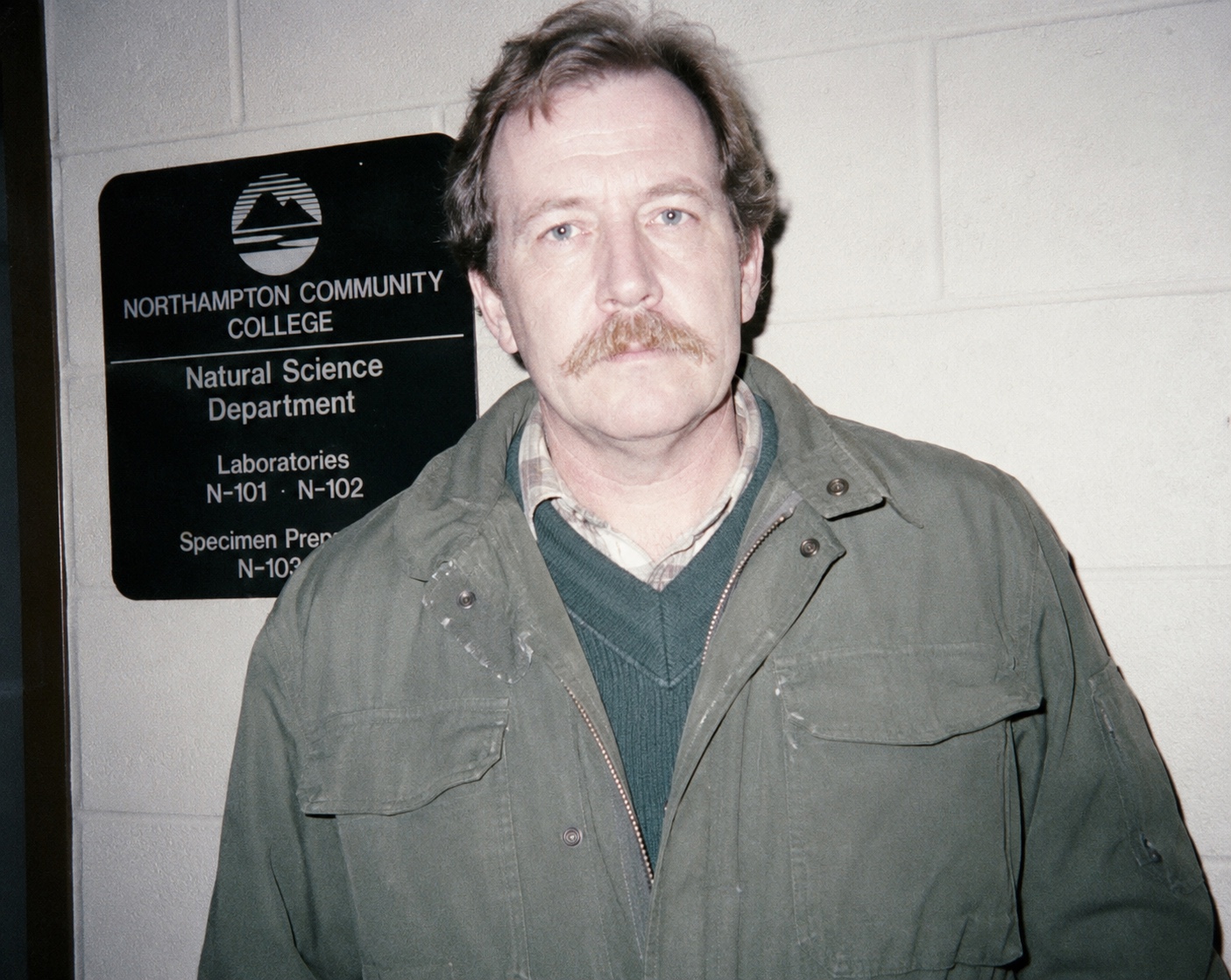
Dr. Elmer V. Spooner after a field-methods lecture, Northampton County, 1994. Photographer unrecorded.
Field Research Office: spooner@cockgoblins.org
Spooner has spent more than three decades compiling first-person accounts, municipal records, field recordings, and physical traces associated with alleged Cock Goblin activity.
Education: B.S., Wildlife Biology, Juniata College, 1978; M.S., Vertebrate Ecology, West Virginia University, 1981; Ph.D., Population Ecology, Temple University, 1986.
Former appointments: adjunct field ecologist, Lehigh Valley Regional Survey Project; seasonal wildlife consultant to three municipal watershed programs; lecturer in field methods and mammalian sign interpretation; adjunct instructor, Natural Science Department, Northampton Community College, 1993–2012, teaching field methods and specimen preparation coursework.
His conventional academic career ended after the 1991 Bethlehem Conference on Northeastern Vertebrate Ecology, where he presented Boundary-Dwelling Unknowns of the Upper Delaware Drainage Basin. During the final session, Spooner played a disputed culvert recording and declined the chair's request to classify it as raccoon activity without further analysis. His university contract was not renewed the following term.
“I am not asking anyone to believe in the Cock Goblin. I am asking why the same thing keeps standing behind people’s sheds.”
Spooner requires independent witness statements, original media where available, precise time and location, weather conditions, conventional-animal review, and a clear distinction between observed behavior and inferred intent.
Current projects include re-indexing pre-1995 mailed reports, digitizing cassette field recordings, comparing PA/NJ drainage-corridor cases, and revisiting repeat sites first documented before widespread trail-camera use.
Spooner begins cataloging unexplained drainage-corridor reports independently after three unrelated witnesses describe similar activity within sixty miles.
The first six-page bulletin is mailed to twenty-three wildlife workers, librarians, amateur naturalists, and prior witnesses.
The disputed presentation ends Spooner's formal university affiliation and shifts the project from academic submission to independent field documentation.
A seventeen-night observation period in Carbon County establishes the Council's current separation of witness interviews, trace collection, and night observation teams.
Case numbering, witness forms, trace classifications, evidence custody sheets, and the standing prohibition on ham are formally adopted.
Twenty-four years of records are geocoded, revealing the present eastern Pennsylvania and northwestern New Jersey concentration.
Public records are reorganized for online access while restricted witness files remain offline.
Spooner’s methods developed within a longer history of internal disputes over terminology, evidence thresholds, and chapter autonomy. See Institutional History and the Scientific Objections memorandum.
Current trace custody, laboratory status, and retained comparison material are listed in the Physical Evidence Catalog.
Methods handbook, 3rd ed. (2019).